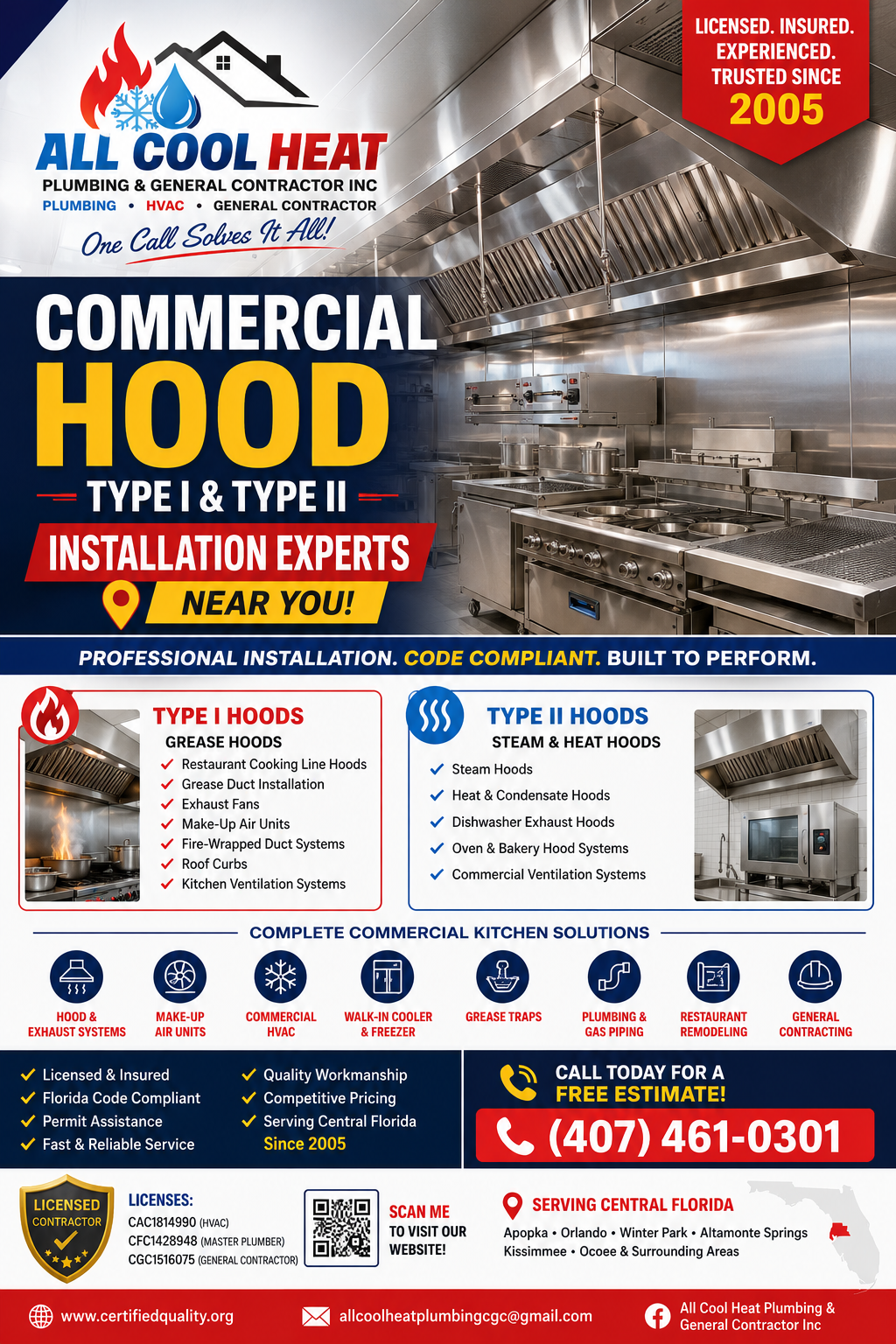
What You Need to Know About Installing a Type II Commercial Hood
A Type II commercial hood (also called a condensate hood) is designed to remove heat, steam, humidity, odors, and condensation. Unlike a Type I hood, it is not approved for grease-laden vapors and cannot be installed over equipment that produces grease.
Equipment Typically Served by a Type II Hood
Commercial dishwashers
Steamers (non-grease producing)
Pasta cookers
Rice cookers
Electric ovens that do not produce grease
Hot holding cabinets
Kettles
Some bakery equipment
Type II Hood Requirements
1. Proper Hood Sizing
Hood must fully cover the equipment.
Overhang requirements are based on local building and mechanical codes.
Hood height and capture area are critical for proper performance.
2. Exhaust Airflow
The exhaust fan must be sized correctly to remove:
Heat
Steam
Moisture
Odors
Undersized fans can cause condensation, mold, and uncomfortable kitchen conditions.
3. Makeup Air
Every exhaust system must be balanced with adequate makeup air.
Without it:
Doors become difficult to open.
The hood loses capture efficiency.
Air conditioning costs increase.
Building pressure becomes negative.
4. Ductwork
Type II exhaust ducts:
Must be properly supported.
Should minimize unnecessary bends.
Must terminate according to local code.
Are generally less restrictive than grease ducts because they do not carry grease.
5. Exhaust Fan
The rooftop or wall-mounted fan should be:
Properly sized
Weather protected
Easily accessible for maintenance
Installed with vibration isolation when required
6. Condensate Management
Steam creates water inside the hood.
A proper installation includes:
Internal condensate collection
Drain channels
Drain connections when required
Fire Protection
Unlike Type I hoods:
Type II hoods generally do not require a fire suppression system, because they are not intended for grease-producing appliances.
If grease-producing equipment is installed beneath the hood, a Type I hood with an automatic fire suppression system is required instead.
Codes and Permits
Installation typically requires compliance with:
International Mechanical Code (IMC)
Local building and mechanical codes
Electrical code
Manufacturer installation instructions
Most jurisdictions also require permits and inspections before operation.
Common Installation Mistakes
Installing a Type II hood over fryers or grills.
No makeup air system.
Incorrect fan sizing.
Poor duct routing.
Improper hood height.
Missing condensate drainage.
Lack of permits and inspections.
Why Hire a Licensed Contractor?
A licensed contractor ensures:
Proper design calculations.
Code-compliant installation.
Correct airflow balancing.
Safe electrical connections.
Reliable system performance.
Successful inspections.
Serving Central Florida
All Cool Heat Plumbing & General Contractor Inc. specializes in commercial kitchen ventilation systems, including:
Type II hood installation
Exhaust fan installation
Makeup air systems
Commercial ductwork
Restaurant renovations
Mechanical and plumbing services
Call (407) 461-0301
Licensed & Insured
HVAC License: CAC1814990
Master Plumbing License: CFC1428948
General Contractor License: CGC1516075
Whether you’re opening a new restaurant or upgrading an existing kitchen in Orlando, Apopka, Winter Park, Altamonte Springs, Kissimmee, or anywhere in Central Florida, professional installation helps ensure your Type II hood operates efficiently, passes inspection, and protects your investment.